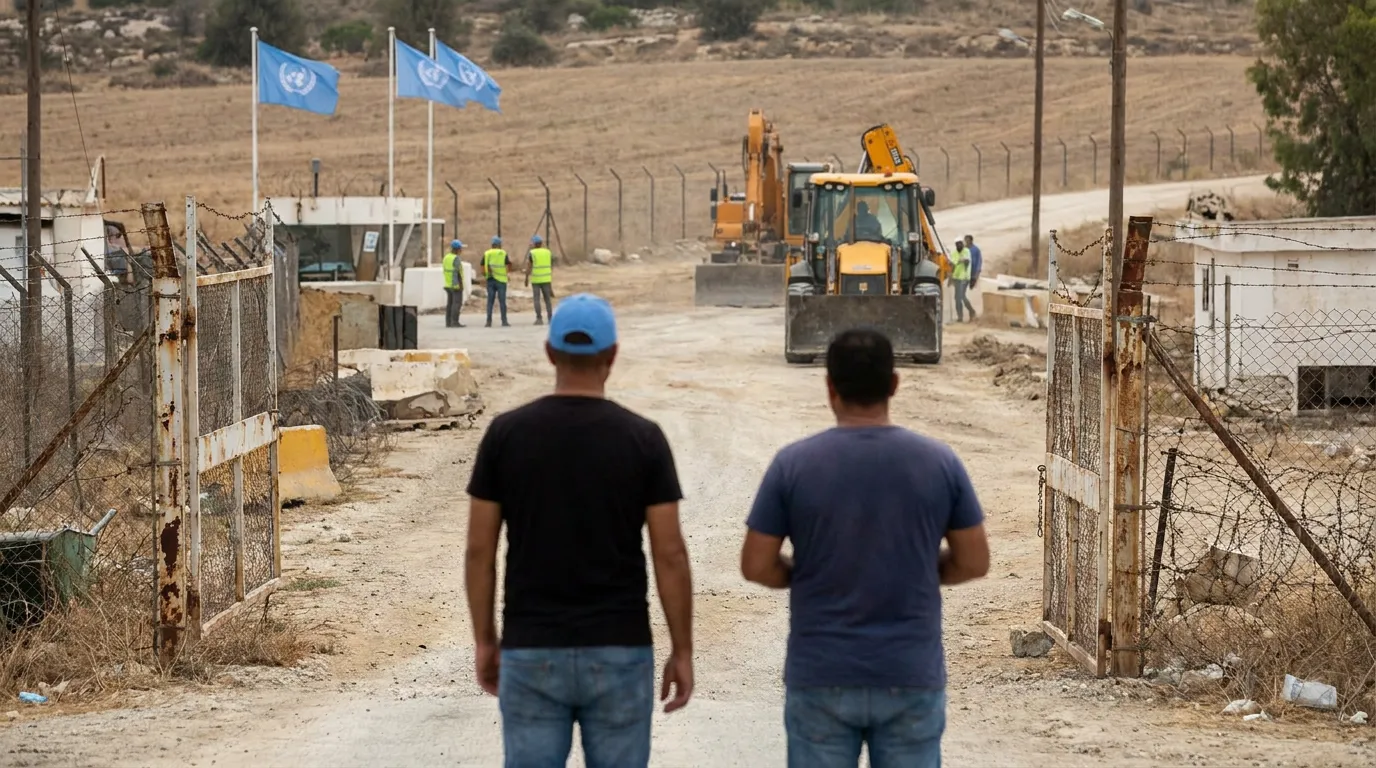
Greek Cypriot and Turkish Cypriot leaders have agreed to open two new crossing points across the United Nations-monitored buffer zone that divides the Mediterranean island, marking the first expansion of the transit network since 2018.
Nikos Christodoulides, president of the internationally recognized Greek Cypriot administration in the south, and Turkish Cypriot leader Tufan Erhürman reached the deal on Monday during nearly four hours of talks in the divided capital of Lefkoşa (Nicosia). The meeting was hosted in the U.N. buffer zone by María Ángela Holguín, the personal envoy of U.N. Secretary-General António Guterres.
The agreement brings the total number of approved crossings along the 180-kilometer (112-mile) cease-fire line to 11. Currently, nine crossing points operate between the two sides, allowing thousands of residents to commute daily for work, trade, education and medical care. The first crossing opened in 2003, ending nearly three decades of closure, while a previous attempt in March to open four additional routes failed.
New routes and confidence-building measures
According to a U.N. statement following the talks, the two new vehicle crossings will open simultaneously: one southeast of the capital linking Akıncılar (Louroujina) with Limya (Lympia), and another in the northwest connecting Gemikonağı (Karavostasi) with Kambo (Kampos). No specific opening date was announced. Christodoulides told reporters that the routes would become operational once the required infrastructure and preparatory work are completed.
Two other proposed crossings—at Mia Milia and Athienou–Pyroi–Aglantzia—remain under discussion alongside unresolved issues regarding mine clearance and access to the bicommunal buffer-zone village of Pile.
Alongside the transit routes, the two leaders approved several bicommunal initiatives aimed at building trust after nearly a decade of diplomatic deadlock:
- Emergency response: The Technical Committee on Crisis Management will establish a joint rapid-response mechanism and disaster coordination center for island-wide emergencies.
- Cultural heritage: Both sides will share archival materials and proceed with the joint restoration of specific Maronite churches and an Armenian monastery.
- Education and environment: The bicommunal "Imagine" peace education project will restart, and the Technical Committee on Environment will advance joint ecological initiatives.
Push to revive stalled peace talks
Both leaders offered measured praise for Monday's outcome while acknowledging the wider political divide. Erhürman, whose election late last year as a pro-federation leader in the north raised hopes for renewed dialogue, described the package as a Turkish Cypriot initiative.
"I regard these as modest steps forward," Erhürman said after the meeting, noting that the results were satisfactory on longstanding practical issues following the stagnation that has persisted since the last formal round of reunification talks collapsed in Crans-Montana, Switzerland, in 2017.
Christodoulides underscored his government's goal of relaunching official negotiations before Guterres steps down as U.N. Secretary-General at year's end. "We are continuing this effort with absolute seriousness and one single goal: resuming the talks before the end of the Secretary-General's term," he said to journalists.
Cyprus has been divided since 1974, when Türkiye launched a military intervention following a coup backed by Greece's then-military junta. The self-declared Turkish Republic of Northern Cyprus (TRNC) is recognized only by Ankara, and disagreements over future governance and Türkiye's role as a guarantor power have repeatedly derailed past reunification efforts.
The U.N. described Monday's discussions as positive and confirmed that Christodoulides and Erhürman will meet again in the coming weeks for a trilateral session with Guterres. During a visit to the island in July, Guterres launched a renewed push to bring together the Cypriot leaders and the island's three guarantor powers—Türkiye, Greece and the United Kingdom—while stressing that any new summit required adequate preparation to yield concrete results.