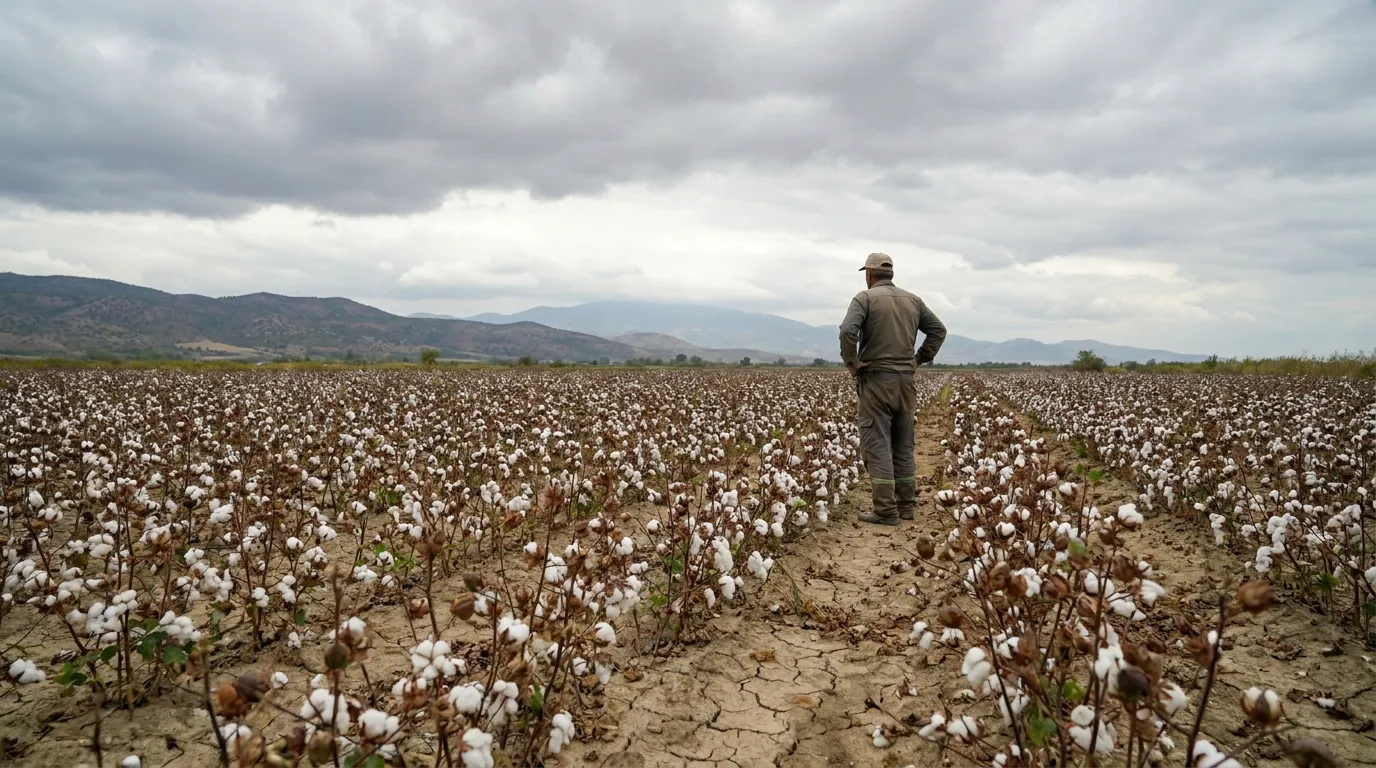
Farmers across western Türkiye are abandoning water-intensive cotton for drought-resistant crops as rising irrigation costs and worsening water scarcity squeeze agricultural margins. The shift highlights the immediate financial strain of climate adaptation on local producers just as Türkiye hosts the United Nations COP31 climate summit in the Mediterranean city of Antalya.
State data agency the Turkish Statistical Institute (TÜİK) forecasts a 38% annual drop in Türkiye's total seed cotton production for 2026, bringing the figure down to 1.2 million metric tons. Meanwhile, local agricultural associations in Söke, a major farming district in the western province of Aydın, say severe water shortages and climbing operational costs have pushed producers to shrink their planted cotton fields by about 60% to roughly 120,000 decares (nearly 29,650 acres).
Rising costs and shrinking cotton fields
For decades, 59-year-old farmer Mehmet Kabak cultivated cotton across his 900 decares (220 acres) of land in Söke. For the current season, he has switched to wheat and sunflowers, which require significantly less water and are cheaper to maintain.
Producers say state agricultural subsidies have not kept pace with soaring fuel and fertilizer prices, which have been driven higher by increased irrigation demands and regional energy market disruptions linked to the U.S.-Israeli war with Iran.
Speaking to Reuters, Kabak highlighted the ongoing surge in the cost of basic agricultural supplies. "We had increases in irrigation costs even though our harvest is damaged," he said, adding: "Our input costs increased by 40%, 50%, 60% continuously. Fuel prices did not stop."
Ranked as the world's eighth-largest cotton producer in 2023 by the UN Food and Agriculture Organization (FAO), Türkiye plays a major role in global textile supply chains. However, its agricultural sector—which accounts for about 5% of national economic output—faces severe structural pressures.
Water scarcity and infrastructure gaps
Agriculture consumes 79% of Türkiye's freshwater supplies, yet government figures show that nearly half of that water is lost before reaching crops due to aging, inefficient canal networks and open-channel irrigation. Farmers who attempt to modernize often run into technical obstacles, such as unfiltered dam water clogging private drip-irrigation hoses.
In 2025, Türkiye experienced its most severe drought in more than 50 years, with national precipitation dropping 27% below the long-term average. Although reservoir levels have partially recovered, analysts warn that the relief is temporary.
An analysis of data from the World Wide Fund for Nature (WWF) and the Lincoln Institute of Land Policy cited by Reuters indicates that water consumption in Türkiye's primary cotton-producing basins must be reduced by 25% to 60% to preserve local ecosystems.
Financing the transition at COP31
How to fund climate resilience is a central point of contention as negotiators from nearly 200 countries gather in Antalya for the two-week COP31 conference, which opened on Monday. While Ankara has allocated 174 billion Turkish lira (approximately $3.5 billion) for public irrigation investments in the coming year, growers are currently bearing the brunt of on-farm adaptation costs.
Ayşegül Selışık, the representative in Türkiye for the United Nations' Food and Agriculture Organization (FAO), underlined the high cost of transitioning to climate-resilient agriculture. "Adaptation is no longer optional for farmers, but it is expensive, and today they largely pay for it themselves," she said.
The International Fund for Agricultural Development (IFAD) estimates that between 5% and 10% of Turkish farmers lack the financial capacity to make major capital investments in climate resilience. Agricultural lenders and industry groups say producers urgently need both technical guidance and accessible credit to overhaul their irrigation systems.
Commenting on the diplomatic talks in Antalya, Selışık said agricultural producers need concrete, actionable measures rather than mere promises. "Success in Antalya should be measured not by pledges, but by how much finance reaches the farm and the watershed," she said.