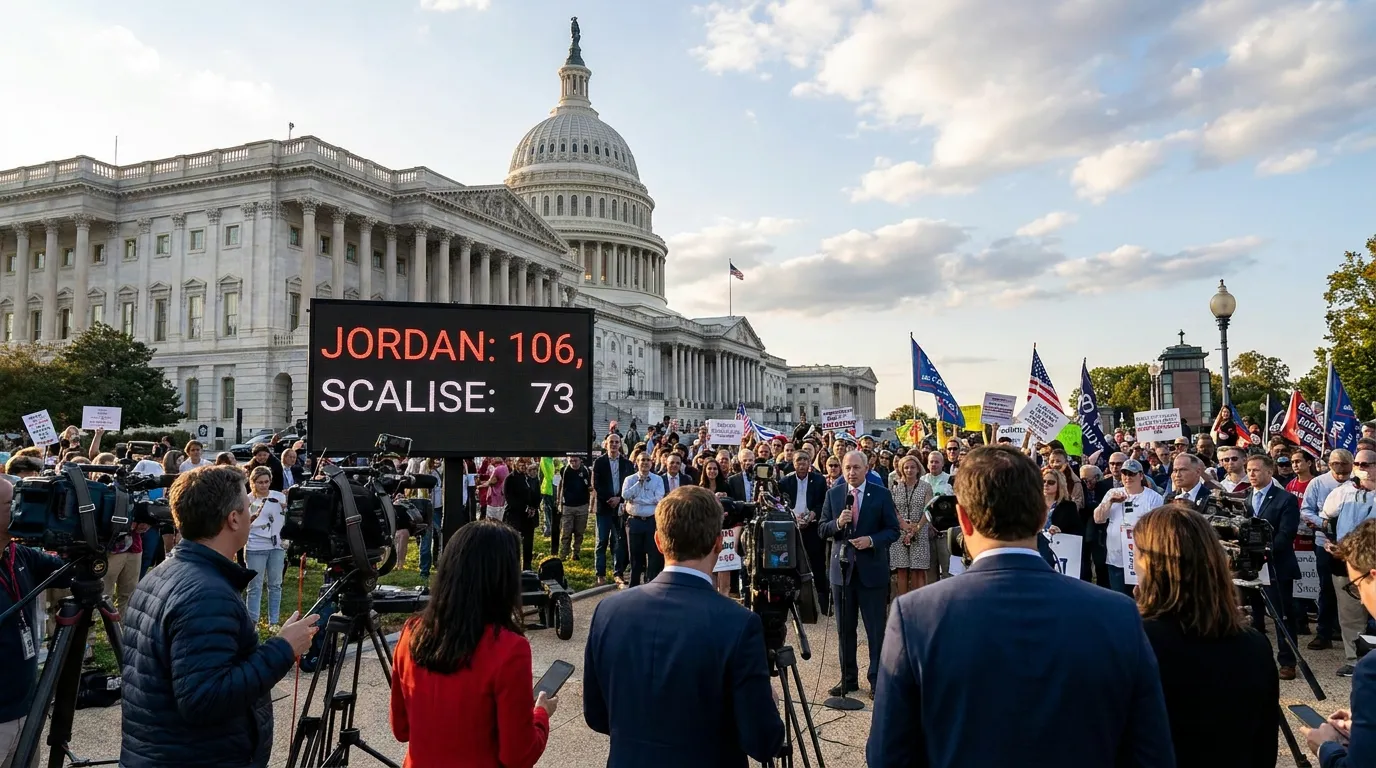
U.S. House Republicans elected Ohio Representative Jim Jordan as their new minority leader on Tuesday, placing a staunch ally of President Donald Trump at the head of the party's congressional opposition after heavy defeats in the midterm elections.
In a closed-door secret ballot of returning lawmakers and incoming freshmen, Jordan defeated current House Majority Leader Steve Scalise of Louisiana by a vote of 106 to 73, according to U.S. media reports. Jordan will succeed outgoing House Speaker Mike Johnson, who announced after last week's elections that he would step down from Republican leadership.
The leadership vote comes one week after the Democratic Party won control of both the House of Representatives and the Senate, stripping Republicans of their governing trifecta for the final two years of Trump's presidency. Republicans lost more than 40 seats in the lower chamber, leaving Democrats with at least 254 seats to the Republicans' 166 as of Tuesday, with 15 races still uncalled.
Shift to an aggressive opposition
By choosing the 62-year-old Jordan over Scalise, who has served in elected party leadership roles continuously since 2014, the Republican conference opted for a confrontational approach to the incoming Democratic majority. Jordan co-founded the ultraconservative House Freedom Caucus in 2015 and has chaired the powerful House Judiciary Committee since 2023.
In his pitch to colleagues ahead of the vote, Jordan argued that his oversight experience made him best suited to counter a wave of anticipated Democratic investigations into the Trump administration, the president's family and his business interests.
"Over the next two years, House Republicans will fight for American families," Jordan told reporters following his election. "When Democrats offer more government, we'll offer more freedom, and we will bring that fight in committee, on the floor and on the stump every single day."
In a candidacy letter to Republican lawmakers, Jordan criticized the party's previous strategic posture, saying Republicans had operated for too long "without a clear plan to survive the hour or the day in front of us." He added that "offense, not defense, wins elections."
A rematch of the 2023 speaker battle
Tuesday's contest was a rematch between Jordan and Scalise, who both ran for House speaker in October 2023 following the ouster of former Speaker Kevin McCarthy. During that three-week leadership standoff, Scalise initially won the internal conference vote before withdrawing when he could not secure the required majority on the House floor. Jordan subsequently failed across three floor ballots, paving the way for Johnson, then a little-known Louisiana lawmaker, to emerge as a consensus choice.
Trump, who endorsed Jordan during the 2023 speaker race, did not publicly weigh in on Tuesday's minority leader contest.
Following the vote, Johnson praised his successor as a longtime mentor and a "fighter." "That's the signal that is being sent here, that they're ready — we are ready — to dig in for the fight," Johnson said. Neither Johnson nor Scalise has confirmed whether they will serve out their full terms as rank-and-file members when the 120th Congress convenes on January 3.
In separate leadership votes on Tuesday, House Republicans elected Representative Tom Emmer of Minnesota to serve as minority whip by a 103-76 tally. Across the Capitol, Senate Republicans re-elected Senator John Thune of South Dakota without opposition to continue leading their conference as he transitions from majority leader to minority leader in January.